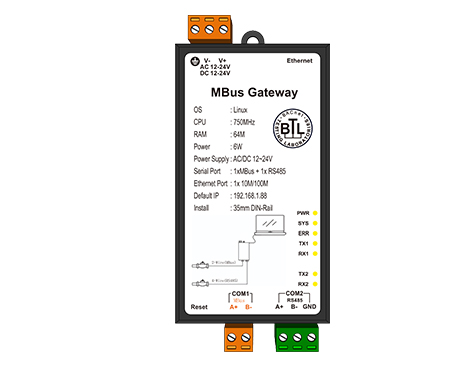
Explore model variants side by side. Compare acquisition scope, forwarding protocols and physical ports, then open a model for its full specifications and documents.
Match device-side protocols and the host system first, then check ports, wireless connections and capacity. Candidates below use confirmed model specifications.
Current model groupPFN1011
Acquisition scope needs confirmation
These models have no listed acquisition scope suitable for this decision. Check their model notes and provide device make, model and protocol documentation.
This guidance narrows the candidates. Confirm communication roles, read/write direction, the point list, wiring and model-specific resources before final selection.
“Unconfirmed” means documentation does not establish a value; it does not mean zero or unsupported.
1 Ethernet port; COM1 is 1 native two-wire MBus port (M+/M-), and COM2 is 1 RS485 serial port (A+/B-). Connect two-wire MBus to COM1 and use a 24 V supply; four-wire MBus communication wires may connect to COM2. Do not interchange these interfaces. The ordinary serial-port count is 1; MBus is counted separately. Check each power edition for its other specifications.
Multiple hardware versions share this model name. Check the matching datasheet; specifications from different versions have not been combined.
1 Ethernet port; COM1 is 1 native two-wire MBus port (M+/M-), and COM2 is 1 RS485 serial port (A+/B-). Connect two-wire MBus to COM1 and use a 24 V supply; four-wire MBus communication wires may connect to COM2. Do not interchange these interfaces. The ordinary serial-port count is 1; MBus is counted separately. Check each power edition for its other specifications.
Multiple hardware versions share this model name. Check the matching datasheet; specifications from different versions have not been combined.